Language
Level

The Czech language exam at level B1 (intermediate level) is intended for foreigners who want to prove that they can communicate independently in everyday situations in the Czech Republic. It tests comprehension of spoken and written language and the ability to actively communicate in everyday life, at school, and in the workplace.
The exam corresponds to level B1 of the Common European Framework of Reference for Languages (CEFR) and passing it serves as official proof of Czech language proficiency for study, work and personal purposes.
The internal exam at level B1 will take place on the dates listed below, either in person at Lidická 9, Brno, or online.
The B1 level exam consists of a written and an oral part; the oral part is only taken if the written part is passed.
The exam can be retaken, but retaking the exam is not included in the price. If you fail one or more parts of the exam, you must retake the entire exam.
If an applicant has been diagnosed with a specific learning disability, the exam conditions can be adjusted. The school must be informed of this fact in a timely manner.
The exam tests whether candidates can use Czech practically and independently in everyday life. The aim is to determine whether you can communicate in Czech in everyday situations, understand written and spoken texts, and express your thoughts clearly.
The candidate should be able to:

understand everyday texts and conversations,
communicate in everyday situations,
describe their experiences, adventures, and plans,
use basic grammar and appropriate vocabulary,
respond clearly and appropriately to the situation.
The emphasis is primarily on the ability to communicate, not on absolute linguistic perfection.
The exam consists of two parts—a written and an oral section. Each part is evaluated separately.
Candidates may take the oral part only after successfully passing the written part.
The written section of the exam lasts approximately 160 minutes in total and consists of 3 parts.
The maximum score for the written section is 75 points. Students must score at least 60% on each part (i.e., at least 15 points) and at least 60% of the total points (i.e., at least 45 points). No points are deducted for incorrect answers.
Dictionaries and cell phones are not allowed during the written section.
Answers must be written on the answer sheet according to the examiner’s instructions.
Duration: 50 minutes
Maximum score: 25
Minimum score: 15
This section evaluates the ability to understand an authentic written text of approximately 400–500 words, which contains common vocabulary corresponding to the B1 level.
MOST COMMON TASK TYPES:
SCORING:
The assessment focuses primarily on the accuracy of text comprehension. Spelling and grammatical errors are not penalized unless they impair the clarity of the answer.
A correct answer is usually awarded 0.5 points or 1 point.
Duration: 30–35 minutes
Maximum score: 25
Minimum score: 15
This section usually consists of several listening passages (the total length of the main text is approximately 4–5 minutes). It evaluates the ability to understand standard spoken language, grasp the main ideas, and note specific details (time, place, numbers, etc.).
MOST COMMON TASK TYPES:
SCORING:
1 point is awarded for each correct answer. Grammar and spelling errors are not penalized unless they affect comprehension.
Duration: 60 minutes
Maximum score: 25
Minimum score: 15
The writing section consists of two tasks.
MOST COMMON TASK TYPES:
SCORING:
Exceeding the required length is not penalized, but failing to meet the minimum length is.
The following are also evaluated:
A maximum of 12 points can be earned for Task 1, and a maximum of 13 points for Task 2.
The oral part lasts approximately 10–15 minutes and is conducted without prior preparation. After the topic is drawn, the candidate responds to the examiner’s questions in the form of a dialogue and short independent statements. The maximum number of points for the oral section is 25.
The evaluation focuses on clarity and fluency of speech, the ability to respond to common communicative situations, lexical and grammatical competence, and pronunciation and intonation.
1. Personal information, personal life, and life circumstances.
2. Home, household, and immediate surroundings.
3. Daily life, employment.
4. Education.
5. Leisure, entertainment, interests, and hobbies.
6. Travel, places visited, and landmarks.
7. Shopping, goods, and prices.
8. Food and drink.
9. Health.
10. Services.
11. Social relationships.
12. Politics, current affairs, and everyday events.
13. Directions and places.
14. Weather.
15. Language and language learning.
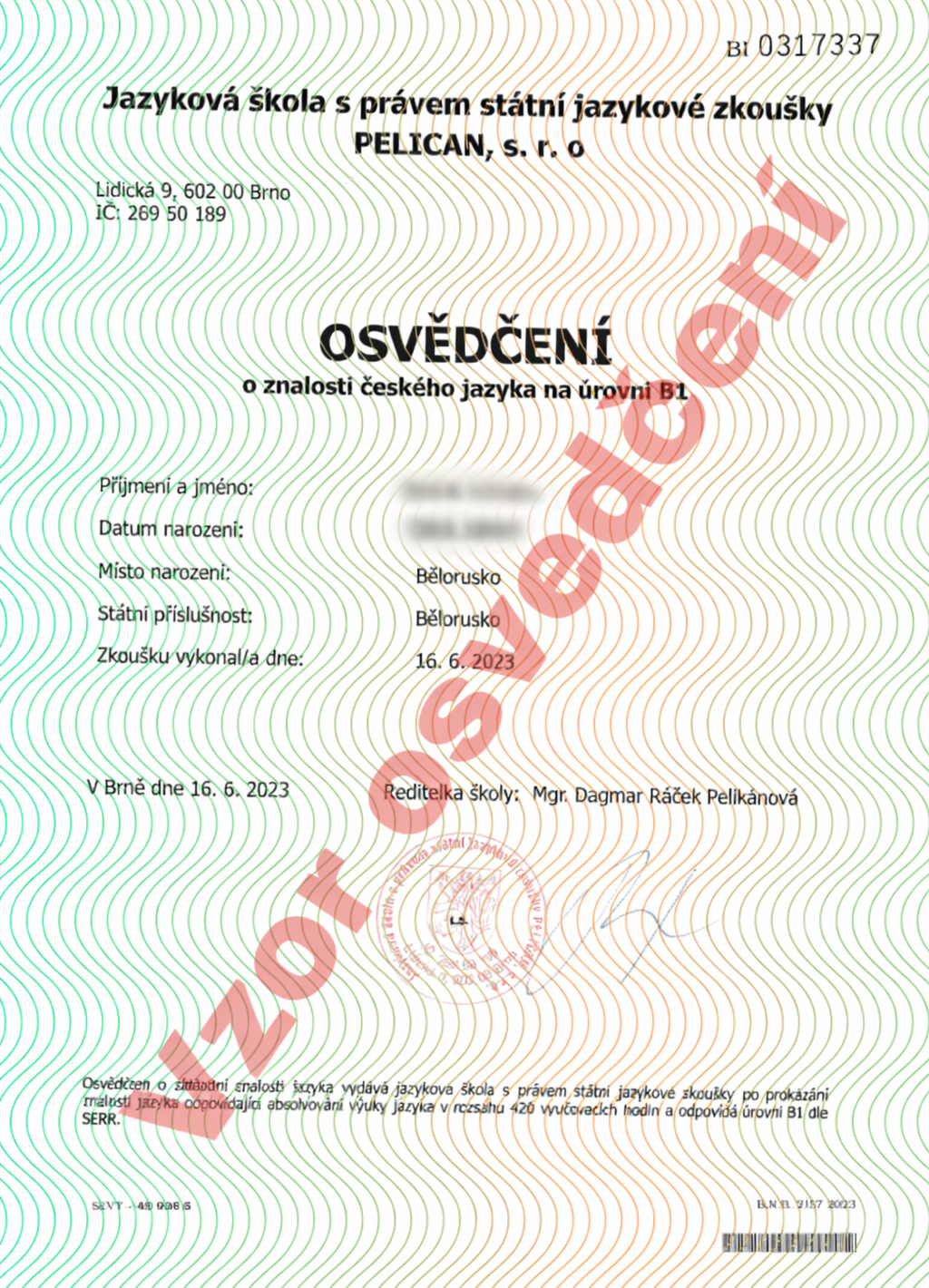
After successfully completing all parts of the exam, the candidate will receive a certificate of achievement of level B1, which serves as official proof of knowledge of the Czech language and can be used for study, work, and personal purposes.
Do not hesitate to contact our language exams coordinator.

KAROLÍNA PETROVÁ
E: info@skolapelican.com
T: +420 774 742 296