Language
Level

The Czech language exam at level C1 (advanced level) is intended for foreigners who want to demonstrate a very high level of knowledge of the Czech language and the ability to use Czech fluently, accurately, and effectively even in demanding personal, study, and professional situations. It tests comprehension of complex written and spoken texts and the ability to express oneself independently and articulately.
The exam corresponds to level C1 according to the Common European Framework of Reference for Languages (CEFR). It is an internal language exam of the PELICAN school, whose structure corresponds to the state language exam – general (level C1).
The internal C1 level exam takes place on individually agreed dates, either in person at Lidická 9, Brno, or online.
The exam consists of a written and an oral part. The oral part can only be taken after successfully passing the written part.
The exam can be retaken, but retaking the exam is not included in the price.
Participation in the C1 Czech language exam is not conditional on completing Czech language courses at the PELICAN language school.
If an applicant has been diagnosed with a specific learning disability, the exam conditions can be adjusted. The school must be informed of this fact in a timely manner.
The exam tests whether the candidate can use the Czech language independently, accurately, and at a very advanced level. It focuses on understanding demanding and more complex texts and on the ability to express one’s own thoughts fluently and articulately in various communication situations.
The candidate should be able to:

understand demanding and more complex written and spoken texts,
express oneself fluently, spontaneously, and accurately,
formulate and defend complex opinions and arguments,
use a rich vocabulary and accurate grammatical structures,
respond flexibly in various communication situations.
Emphasis is placed on linguistic accuracy, argumentation skills, and refined expression.
The exam consists of two parts—a written and an oral section. Each part is evaluated separately.
Candidates may take the oral part of the exam only after successfully passing the written part.
The written section lasts 240 minutes and is divided into two parts, with a 15–20-minute break in between.
In the first part of the exam, candidates may use a physical dictionary (reading and writing). The dictionary must be in physical form, and candidates must bring their own.
During the exam, candidates are not allowed to talk to other candidates or use mobile devices.
At the beginning of each section, the examiner will distribute the corresponding exam questions, which are to remain closed until instructed to open them. At the end of each section, the examiner will collect both the exam questions and the answer sheet. Answers must be written on the answer sheet. You may write on the exam questions as you wish; only the answer sheet will be graded.
The maximum number of points for the written section is 120 (30 points for each part). The minimum total score required to pass the written section is 60 points (inclusive). The minimum score for each part is 15 points (inclusive). No points are deducted for incorrect answers.
Duration: 55 minutes
Maximum points: 30
Minimum points: 15
This section consists of 3 texts, based on which the candidate completes the assigned tasks. The texts are usually articles from Czech periodicals and media outlets such as seznam.cz, prozeny.cz, blesk.cz, etc. You must rely solely on the information provided in the text. This section assesses your ability to understand and work with written text.
MOST COMMON TASK TYPES:
SCORING:
For open-ended answers, both grammar and spelling are evaluated, with 0.5 points deducted for each error. No points are deducted for incorrect answers. Correct answers are awarded between 0.5 and 1 point.
Duration: 85 minutes
Maximum score: 30
Minimum score: 15
The free writing section consists of two parts. In Task 1, the candidate chooses one of the two given topics and writes an essay on it. The essay on the first topic should be 380 to 440 words long. Task No. 2 is a given topic; the length is 50 to 60 words.
MOST COMMON TASK TYPES:
Optional topic
Mandatory topic
SCORING:
Optional topic – maximum points: 23
Mandatory topic – maximum points: 7
15–20 minutes
Duration: 40 minutes
Maximum score: 30
Minimum score: 15
Listening comprehension typically consists of 3 audio clips, based on which the candidate completes the assigned tasks. The texts are usually articles or interviews (dialogues) from Czech periodicals and media outlets such as seznam.cz, prozeny.cz, blesk.cz, etc. You must rely solely on the information provided in the text.
MOST COMMON TASK TYPES:
SCORING:
Duration: 55 minutes
Maximum score: 30
Minimum score: 15
The grammar and vocabulary test typically consists of 10 tasks and assesses the practical use of Czech and the ability to apply grammar and vocabulary in context.
MOST COMMON TASK TYPES:
SCORING:
In the oral part of the exam, the candidate draws two topics—one conversational and the other focused on cultural knowledge. After drawing the topics, the candidate has 10–15 minutes to prepare. This time is used to jot down the key points they wish to mention in their response.
The oral exam takes the form of a natural dialogue with the examiner. The candidate should speak fluently and coherently and answer as accurately as possible. The examiner also assesses the candidate’s ability to respond spontaneously, discuss the given topic, and react appropriately in everyday communication situations.
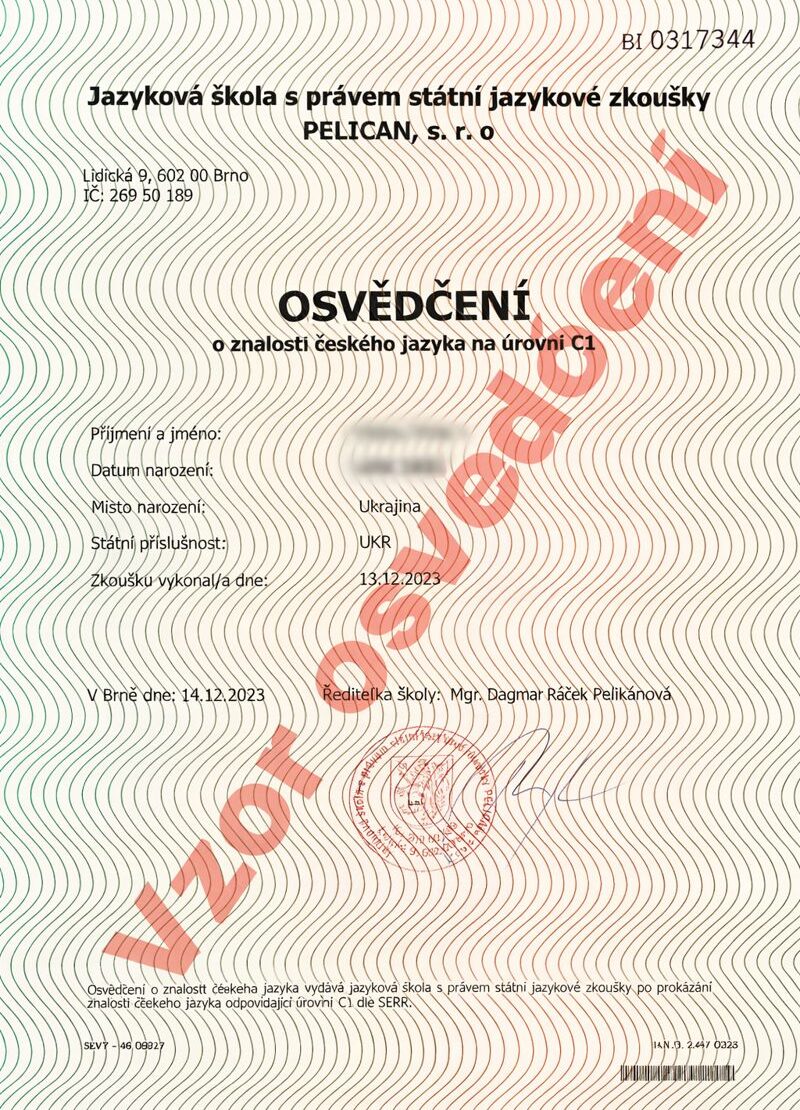
After successfully completing all parts of the exam, candidates will receive a certificate confirming that they have achieved level C1, which serves as official proof of a very advanced knowledge of the Czech language and can be used in study, work, and professional life.
Do not hesitate to contact our language exams coordinator.
KAROLÍNA PETROVÁ
E: info@skolapelican.com
T: +420 774 742 296